
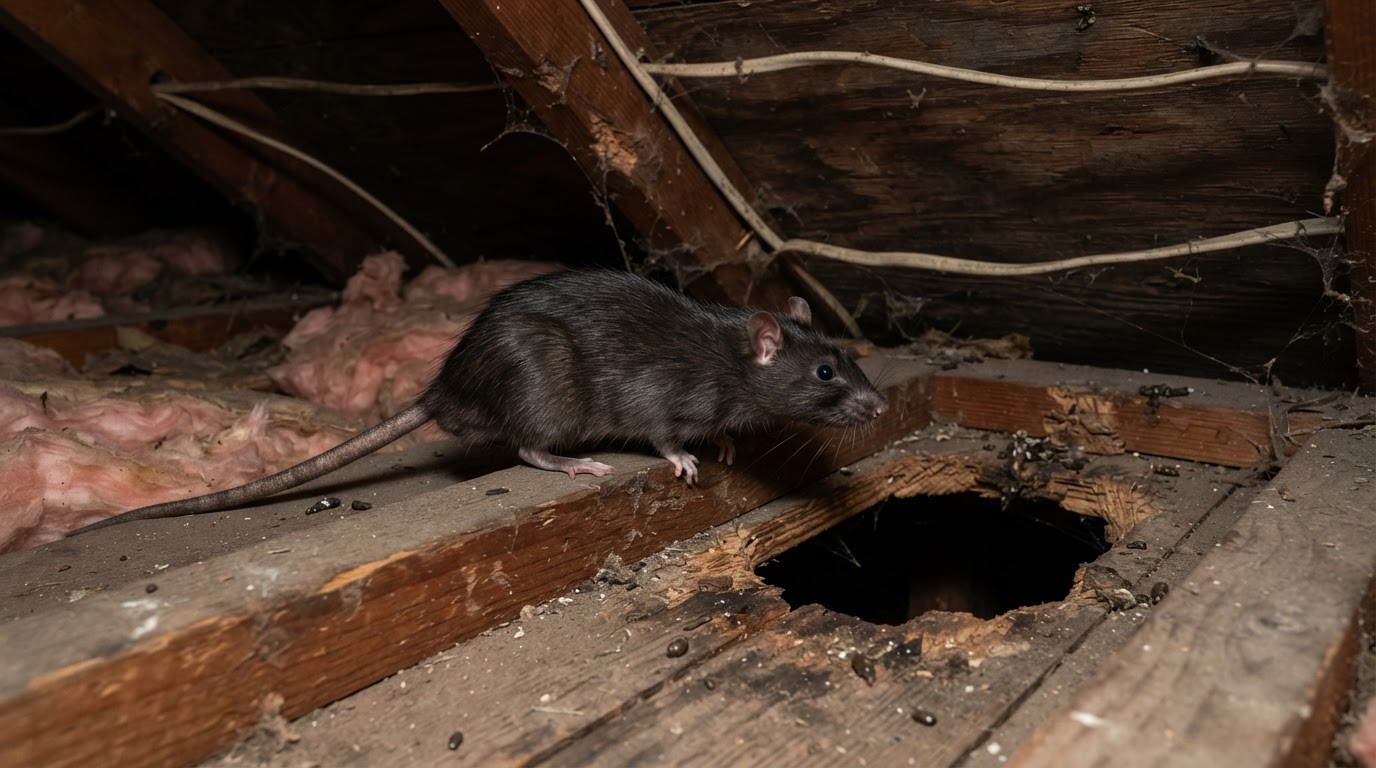
Roof Rats
Rattus rattus
Also known as black rats or ship rats, roof rats are agile climbers that prefer to live and nest in upper parts of buildings, like attics and drop ceilings.
Roof rats (Rattus rattus), also known as black rats or ship rats, are one of the most common rodent pests in Coastal Georgia. Unlike Norway rats, which tend to burrow, roof rats are excellent climbers that prefer to nest in elevated areas — attics, rooflines, drop ceilings, and upper stories of homes.
Roof rats are particularly problematic in neighborhoods with mature trees, overhanging branches, and dense vegetation — conditions found throughout Brunswick, St. Simons Island, and the Golden Isles. They use tree limbs, power lines, and vines to access roofs and find entry points into attics and wall voids.
Once inside, roof rats can cause significant damage by gnawing on wiring (which is a fire risk), destroying insulation, and contaminating surfaces with droppings and urine. They're also known carriers of parasites like fleas and mites. Professional rodent defense combines interior trapping, exterior monitoring, and exclusion to address the problem comprehensively.
How to Identify Roof Rats
Roof rats are smaller and sleeker than Norway rats, with a body built for climbing. Their coloration and physical features help distinguish them from other rodent species.
- Adults range from 13 to 18 inches total length, including the tail
- Sleek, slender body with soft, dark brown to black fur
- Tail is longer than the head and body combined — a key identifier
- Large ears that lay flat against the head when pulled forward
- Pointed snout and large eyes
Behavior and Habitat
Roof rats are nocturnal, agile climbers that prefer elevated nesting sites. They're omnivorous but show a strong preference for fruits, nuts, and seeds — which is why they thrive in Coastal Georgia's tree-canopied neighborhoods.
- Excellent climbers — use tree limbs, power lines, ivy, and fences to access roofs
- Prefer to nest in attics, roof spaces, drop ceilings, and upper wall voids
- Nocturnal — most active at night
- Omnivorous — eat fruits, nuts, seeds, pet food, and bird seed
- Can squeeze through openings as small as 1/2 inch
Signs of Roof Rat Activity
Roof rats are secretive and nocturnal, but they leave behind several detectable signs — especially in attics and upper areas of the home.
- Scurrying or scratching sounds in the attic or walls at night
- Droppings that are about 1/2 inch long with pointed ends — often found in attics
- Gnaw marks on wood, wiring, PVC pipes, and ductwork
- Greasy rub marks along travel routes — dark smudges on beams and pipes
- Nests made of shredded insulation, paper, and fabric in attic spaces
- Chewed entry holes at rooflines, gable vents, or soffit areas
Where You'll Find Them
Roof rats are elevated nesters. Unlike ground-dwelling rodents, they target the upper parts of homes and structures — which is why many homeowners don't realize they have a problem until it's well established.
Health and Property Risks
Roof rats cause damage that goes beyond nuisance. Their nesting, gnawing, and waste can create real safety and health hazards.
- Fire risk — gnawed electrical wiring is a leading cause of rodent-related house fires
- Structural damage — destroyed insulation, chewed ductwork, and damaged wood
- Disease transmission — roof rats can carry leptospirosis, salmonellosis, and rat-bite fever
- Parasites — fleas, mites, and ticks that ride in on rats can infest the home
- Contamination — droppings and urine in attic spaces require professional cleanup
- Rapid reproduction — a single pair can produce dozens of offspring in a year
When to Call a Professional
Roof rats are not a pest to handle with traps alone. Their nesting in hard-to-reach areas and rapid reproduction mean professional intervention is usually necessary.
- You hear scratching or scurrying sounds in the attic or walls at night
- You've found droppings in the attic, garage, or upper cabinets
- You notice gnaw marks on wiring, wood, or pipes
- You see rats traveling along rooflines, fences, or power lines at dusk
- You've found entry holes at the roofline, gable vents, or soffits
- You smell a musty or ammonia-like odor in the attic
Why Coastal Georgia Makes It Worse
Coastal Georgia's abundant live oaks, Spanish moss, and mature tree canopy create ideal habitat for roof rats. Neighborhoods throughout Brunswick, St. Simons Island, and surrounding areas have the overhanging limbs, dense vegetation, and warm climate that allow roof rat populations to thrive year-round. Homes with gable vents, soffit gaps, or tree limbs touching the roofline are especially vulnerable — roof rats use these as highways directly into your attic.
Dealing with roof rats in your home?
Schedule a free, no-obligation inspection. We'll identify what's there and build a targeted plan.
What Homeowners Can Do
Roof rat prevention focuses on denying access to your home and reducing the conditions that attract them. These steps support professional rodent defense programs.
- Trim tree branches at least 6 feet away from the roofline — roof rats use limbs as bridges
- Seal gaps and holes around the roofline, gable vents, and soffits
- Keep ivy and vines trimmed away from exterior walls — roof rats climb them
- Store bird seed, pet food, and garbage in sealed containers
- Schedule professional exterior monitoring to intercept rodent pressure before entry
Frequently Asked Questions
Ready to Get Vengeance on roof rats?
Our licensed technicians will inspect your property, identify the problem, and build a targeted treatment plan — at no cost to you.