
That Nest Under Your Eaves
How to Identify Wasps, Hornets, and Yellow Jackets in Coastal Georgia
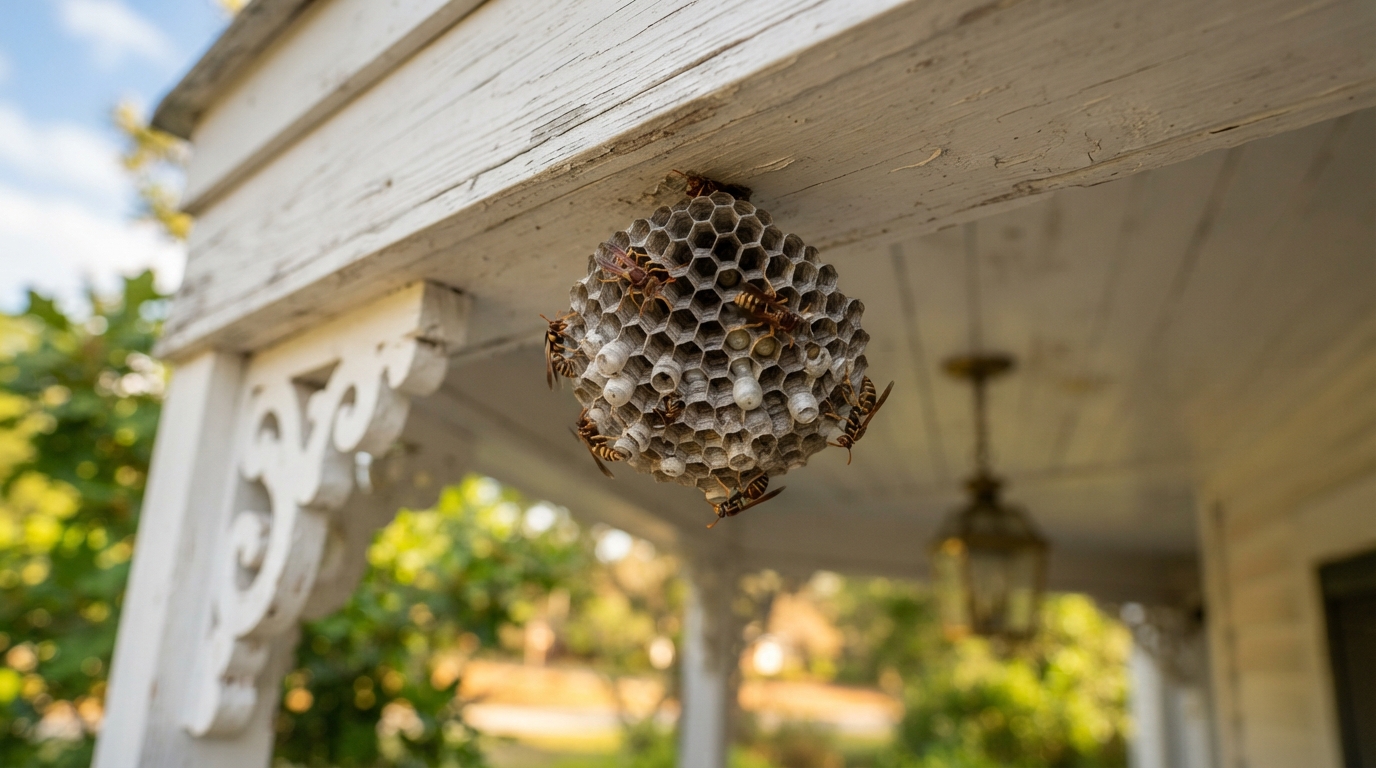
You're walking out the back door with a glass of sweet tea, heading toward the patio, when something buzzes past your ear a little too close for comfort. You look up. There — tucked under the overhang of your eave — is a gray papery structure that definitely was not there last month.
Sound familiar? If you're a homeowner in Coastal Georgia right now, you're in good company. We've been hearing it from families on the south end of Brunswick, from homeowners over by the marshes in Sterling, and from folks out on Saint Simons — both up on the north end of the island and down closer to the Village. August is peak stinging insect season in this part of Georgia, and this is exactly when people start noticing nests that have been quietly growing all summer long.
Before you grab anything from the garage or think about knocking it down with a broom handle, stop and read this first. The single most important thing you can do is identify what you're dealing with — because wasps, hornets, and yellow jackets don't all look the same, they don't all build the same kind of nest, and they definitely don't all behave the same way.
Quick Answers (Key Takeaways)
- How do I identify a paper wasp nest? Look under eaves for open, umbrella-shaped honeycomb nests with downward-facing cells.
- Why are yellow jackets dangerous? They often nest underground in lawns or landscaping, forming massive colonies that aggressively attack when disturbed.
- What does a bald-faced hornet nest look like? A large, bloated football-shaped gray papery structure suspended in trees or tall shrubs.
- What should I do if I find a nest? Do not disturb or spray it yourself. August colonies are at peak size and highly protective — request professional inspection and removal.
Here's a practical guide to the most common stinging insects you'll encounter in Coastal Georgia this time of year: where they build, what to look for, and when to take it seriously.
Paper Wasps: The Most Common Eave-Builder
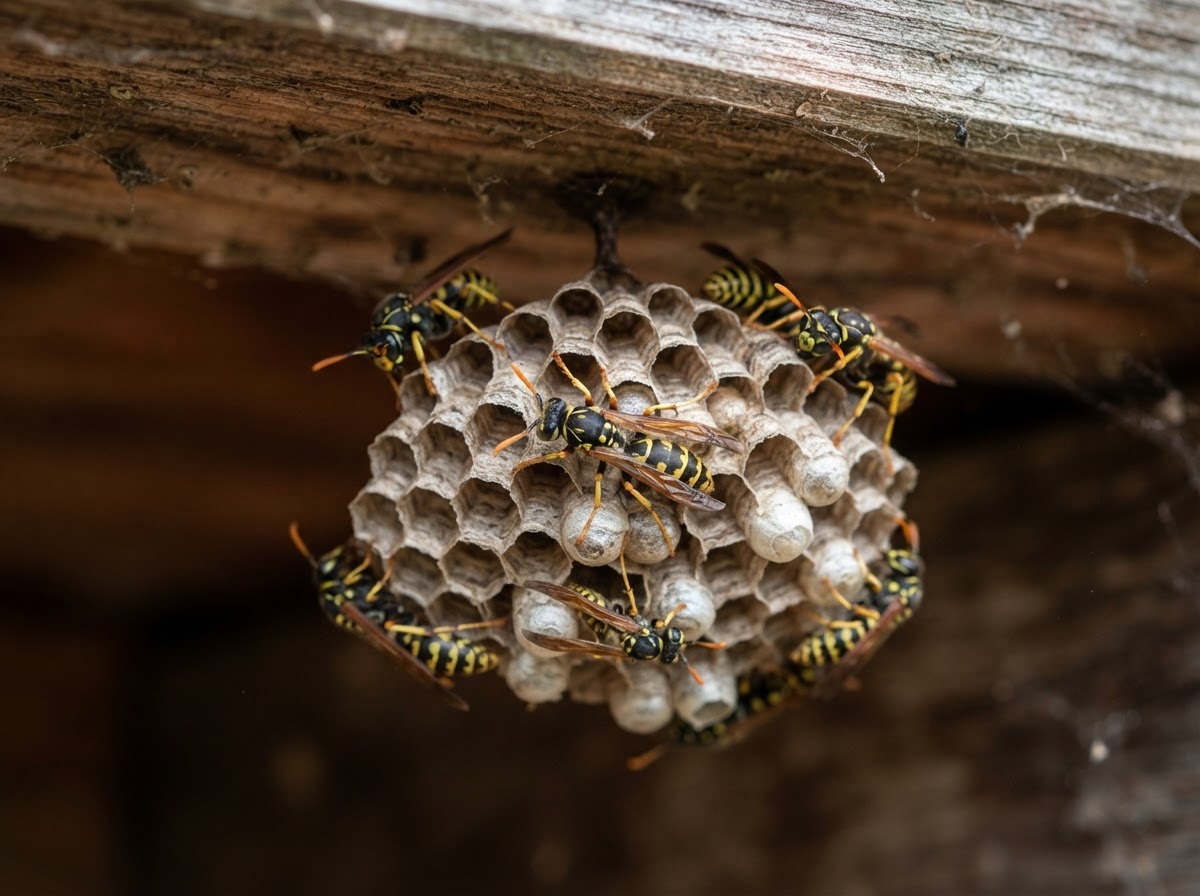
Paper wasps — sometimes called umbrella wasps — are probably the stinging insect most Coastal Georgia homeowners run into first. They're slender, brownish insects with various orange markings, and they build open, honeycomb-style nests with downward-facing cells that look a bit like an inverted umbrella cap suspended from a short stalk.
They nest under the eaves of houses, on porches, in attics, or in dense shrubbery — and nests in those spots can become a real problem by mid-summer. Their nests are small compared to those of yellow jackets and hornets and contain up to about 250 wasps.
Here's some reassurance: unlike the more aggressive yellow jackets and hornets, paper wasps typically only attack when they or their nest are directly threatened. But "typically docile" doesn't mean safe — especially when a nest is built right next to a doorway, a window frame, or a play structure. And if your home has older wood siding, overhanging trees, or covered porches — which describes a lot of the homes on the south end of Brunswick and along the marsh-side streets near 17 North — you're exactly in the sweet spot these wasps prefer. August is when their colonies are at their fullest.
Yellow Jackets: Small, Fast, and Fiercely Territorial
Yellow jackets are small — about half an inch long, marked with black and yellow banding. At a glance they look a lot like paper wasps, but there are real differences: yellow jackets have a thicker waist, shorter legs, and wings that press more flatly against the body when resting than wasps do.
Their nesting behavior is what makes them genuinely dangerous for homeowners. Colonies are initiated by overwintering queens that make paper nests underground — but occasionally they'll use hollow trees, wall voids, and attics. That ground nest is the one that catches people off guard. You may not know it's there until you've already disturbed it by mowing or walking nearby.
A fully developed yellow jacket colony can grow to contain hundreds to many thousands of adults. And behaviorally, they become very aggressive as a group if their nest is threatened — they will vigorously pursue an intruder and are generally considered the most dangerous of the social stinging insects.
If you're spending time in a yard with any amount of ground cover, tree roots, or landscape beds — think the wooded lots off Exit 29, the larger properties over in Sterling, or the older residential yards on the north end of Saint Simons — a yellow jacket ground nest is a real possibility and often the last thing homeowners see coming. Check our Pest Library to learn more about stinging insect habits.
Yellow jackets will also forage for meat and soft drinks at picnic and outdoor dining sites — which is exactly why they show up uninvited to every late-summer cookout.
Bald-Faced Hornets: The Football in Your Tree
Need Professional Pest Control?
Don't let pests take over your Coastal Georgia home. Get a customized treatment plan today.
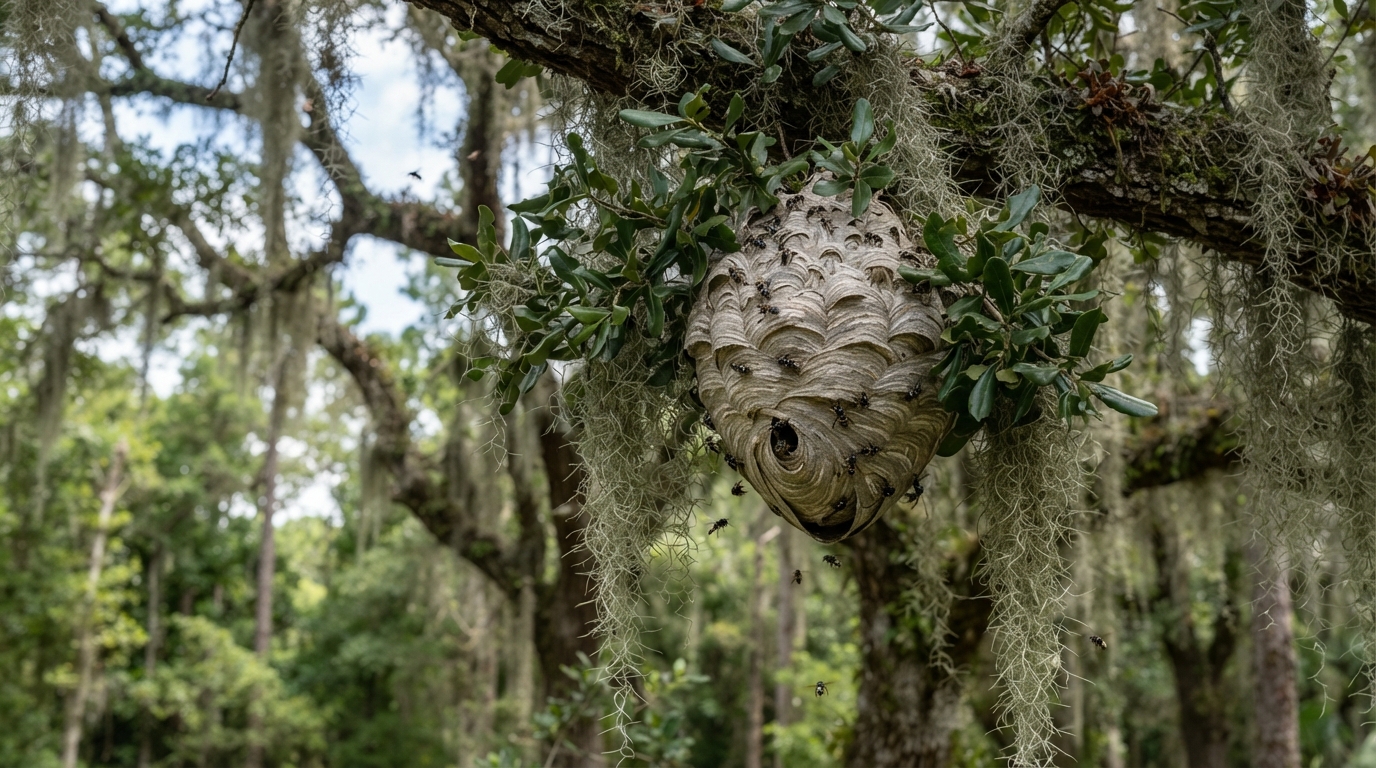
If you've spotted what looks like a large gray papery structure hanging from a tree, a bush, or a building overhang, that's likely a bald-faced hornet nest. Despite the name, the bald-faced hornet is actually a type of yellow jacket.
White or light yellowish markings on the face, thorax, and part of the abdomen help to identify them. Their nests are suspended in trees and shrubs and often described as looking like a "bloated football" — usually with a single entrance opening at the lower end.
These nests are made of chewed wood fiber — the same papery material as paper wasp nests — and they grow steadily all summer. By August, homeowners often call after finding a nest that has reached the size of a basketball. That doesn't happen quickly. You've likely been living alongside that colony for months.
Out here on the coast, where the live oaks, Spanish moss, and dense marsh-side vegetation are part of everyday life — from the neighborhoods off 17 North to the island's north end — bald-faced hornet nests can blend right into the tree canopy until they've grown too large to ignore. Give any nest you find wide clearance. These insects are highly defensive.
European Hornets: Georgia's Largest Stinging Insect
The European hornet is a large insect — over one inch long — brown with yellow abdominal stripes and pale faces. They are often confused with yellow jackets at first glance, but their size sets them apart immediately.
Nests are typically found in woodlots, sheds, barns, and occasionally in wall voids or attics of homes near wooded areas — which describes a good portion of the properties along the marsh corridors in Brantley and Darien or Townsend, and the more wooded neighborhoods out toward Sterling and the areas surrounding Exit 29.
One specific behavior worth knowing: European hornets are active at night and attracted to lights. If you're noticing large hornets flying toward your porch light or exterior fixtures after dark, that's a signal worth taking seriously.
Where to Look Around Your Home This Month
The Homeowner Habits That Matter
Here are four spots worth checking in August — no matter what part of our service area you call home:
- Under your eaves, overhangs, and porch ceilings. This is prime paper wasp territory. Look for a small, open-cell honeycomb structure suspended from a short stalk. Covered porches and older homes — common on the south end of Brunswick and along the marsh-facing streets near Sterling — are especially prone.
- In your lawn and landscaping. Unexplained holes in the ground with repeated flying insect traffic coming and going could indicate a yellow jacket ground nest — one of the harder ones to spot until it's too late. If you maintain a larger yard or wooded lot, check the edges of landscaping beds and tree root zones.
- In trees and tall shrubs. A large, round, gray papery structure hanging from a limb is likely a bald-faced hornet nest. The bigger it is, the longer it's been there. The oak and pine canopies throughout Coastal Georgia — from the north end of Saint Simons right down through the marsh neighborhoods on 17 North — are prime real estate for these nests.
- Near outdoor lights after dark. Large hornets appearing at exterior lights in the evening may indicate a European hornet nest somewhere on or near your property.
What to Do When You Find One
Here's the most important takeaway from everything above: don't approach it, disturb it, or attempt to remove it on your own.
During the summer months, colonies rapidly increase in size and can reach several hundred to several thousand workers by the time you spot the nest. August is when that population is at or near its peak — and the colony is at its most protective. What looks manageable from a distance is a fast, organized, reactive group of stinging insects that don't need much of an excuse to respond.
If you think you may have a nest on or near your home — visible or not — a professional inspection is the right next step. At Vengeance Pest Solutions, our Vengeance® Sting Defense program begins exactly there: a thorough inspection to identify the species, locate the nest, and build a targeted plan for your specific property — whether you're on the south end of Brunswick, out on the island, over by the marshes near Sterling, or anywhere else in our service area.
Your yard should feel safe for your family, your children, and your pets this summer. If you're not sure what's living under your eaves or in your lawn right now, call us at 912-268-3150 or Book a free evaluation here.
Don't wait until someone gets stung to find out what's out there.